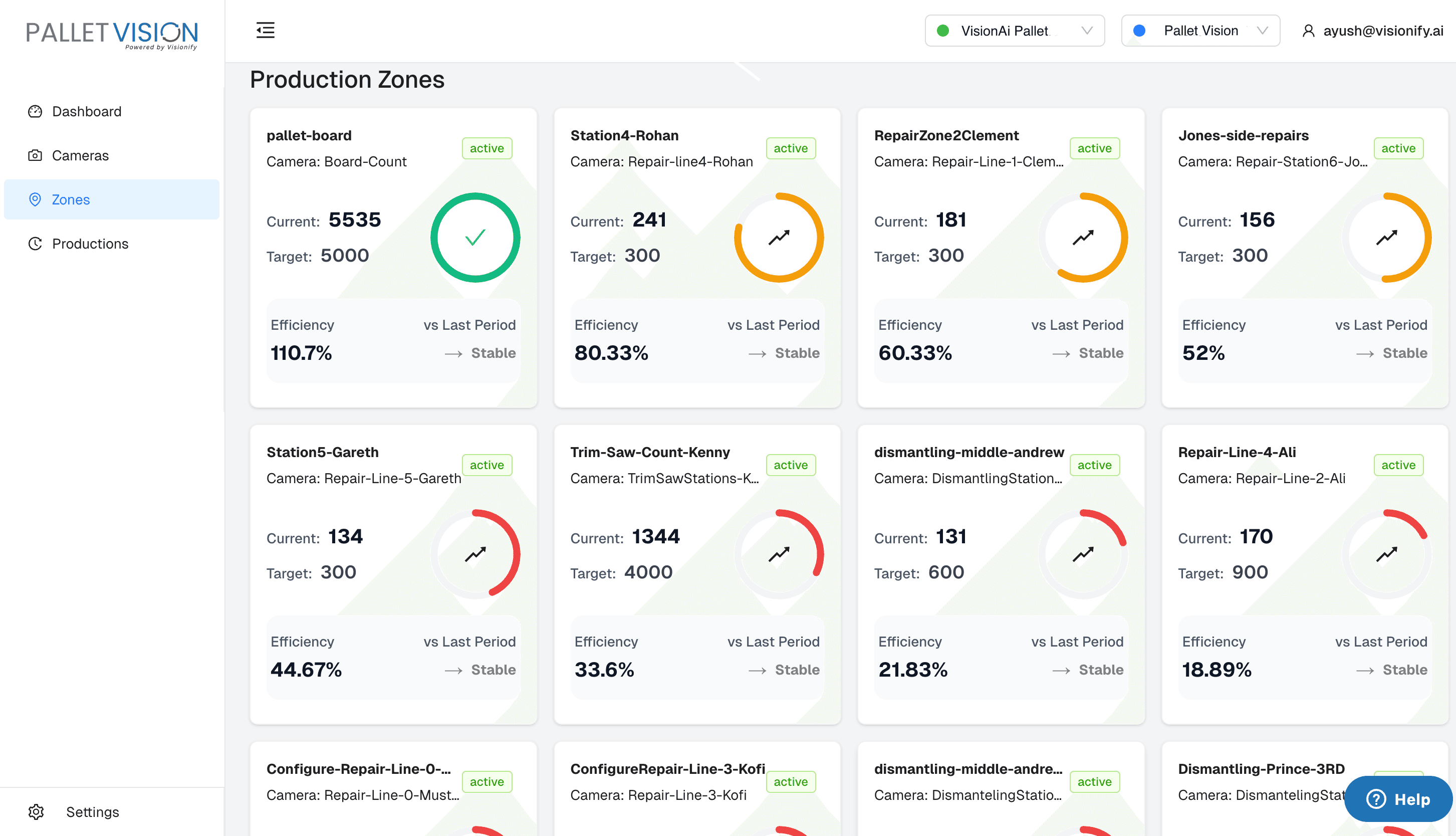
Switching from manual counting to AI-powered tracking is not just a technology upgrade — it is a financial decision. Here is a clear-eyed look at what pallet companies should expect in terms of ROI during their first year with AI tracking.
The Cost of Doing Nothing
Before calculating ROI, it helps to understand what manual counting actually costs. Most operations underestimate this because the costs are distributed across labor, errors, and delayed decisions.
Direct counting labor: A typical operation spends 20-40 hours per week on counting and verification. At loaded labor rates of $25-35/hour, that is $26,000-$72,800 per year.
Error costs: Manual counting has a 5-10% error rate. Each error can cascade into billing disputes, inventory write-offs, and rework. Conservative estimates put this at $10,000-$30,000 per year.
Decision lag: When production data arrives 4-8 hours after the fact, you cannot respond to problems in real time. The cost of delayed scheduling, missed bottlenecks, and reactive (instead of proactive) management is real but harder to quantify.
What AI Tracking Costs
PalletVision pricing varies based on the number of sites, stations, and cameras. But for a typical mid-size operation with 4-8 stations:
- Hardware: Edge AI device + cameras (if needed). One-time cost.
- Software: Monthly subscription per station.
- Setup: 1-3 day deployment, included in onboarding.
Year One ROI Breakdown
Here is what a typical operation with 6 stations sees in year one:
| Category | Annual Savings |
|---|---|
| Counting labor eliminated | $30,000 - $55,000 |
| Error and dispute reduction | $10,000 - $25,000 |
| Scheduling improvements | $5,000 - $15,000 |
| Total savings | $45,000 - $95,000 |
Against a typical annual cost of $15,000-$30,000 for PalletVision (subscription + hardware amortized), most operations see 2-4x ROI in year one.
Beyond the Numbers
Some benefits are harder to put a dollar figure on but matter just as much:
- Supervisor time reclaimed. Instead of walking the floor to check counts, supervisors manage by exception using the dashboard.
- Team accountability. When everyone sees the same numbers in real time, performance conversations become data-driven instead of subjective.
- Faster onboarding. New hires do not need to learn counting procedures — the system handles it.
When to Expect Payback
- Operations with 6+ stations: Typically see payback within 4-8 months.
- Operations with 2-4 stations: Typically see payback within 8-12 months.
- Operations already using PalletConnect ERP: See additional ROI from eliminated manual data entry.
The Bottom Line
AI pallet tracking is not an experiment anymore. It is a mature technology deployed in production environments. The question is not whether it saves money — it is how much and how fast.